
Guide / accounting and stock
Inventory management and QuickBooks
QuickBooks carries a real inventory module — fine for simple stock inside the books. The ceiling arrives with purchasing discipline, batch tracking and multi-location truth. Here is where the module stops, and BSimple's status stated plainly.
The key facts
- QuickBooks' built-in inventory is real: products, quantities on hand, purchase orders, basic reports — inside the accounting system.
- Its ceiling: live multi-location truth, batch/expiry, pick-pack workflows and customer portals — the warehouse-grade layer.
- The integration floor: invoices cross without re-entry, quantities stay true both ways, reconciliation survives — or it is just an export.
- BSimple's status: the accounting handoff is Xero and MYOB; US accounting integrations are rolling out — no finished QuickBooks claim.
- Context: the full inventory system holds the wider system, this page one stop in it.
- 01The key facts
- 02What QuickBooks' own inventory covers
- 03BSimple's boundary with QuickBooks — stated plainly
What QuickBooks' own inventory covers
Inside QuickBooks — Online in particular — the inventory module handles a legitimate slice of the job: products and services with quantities on hand, purchase orders and bills, cost tracking, and basic low-stock reporting. For a business whose stock lives in one place, moves at counter-sale speeds, and reports annually, it can be enough — and staying inside the accounting system is a genuine simplification: no sync, no boundary, no second vendor.
The ceiling shows up as operations: quantities that update on invoice events rather than real warehouse movements; one location model where a warehouse, a van and a shop need three truths; no batch or expiry discipline where products carry lots; no pick-sequence or packing slips for a floor team; and no customer portal for wholesale buyers with their own pricing. Those are the jobs of an operations record — the layer this page's neighbours inventory that works with QuickBooks, the QuickBooks Online angle and the Desktop-specific question cover in detail.
BSimple's boundary with QuickBooks — stated plainly
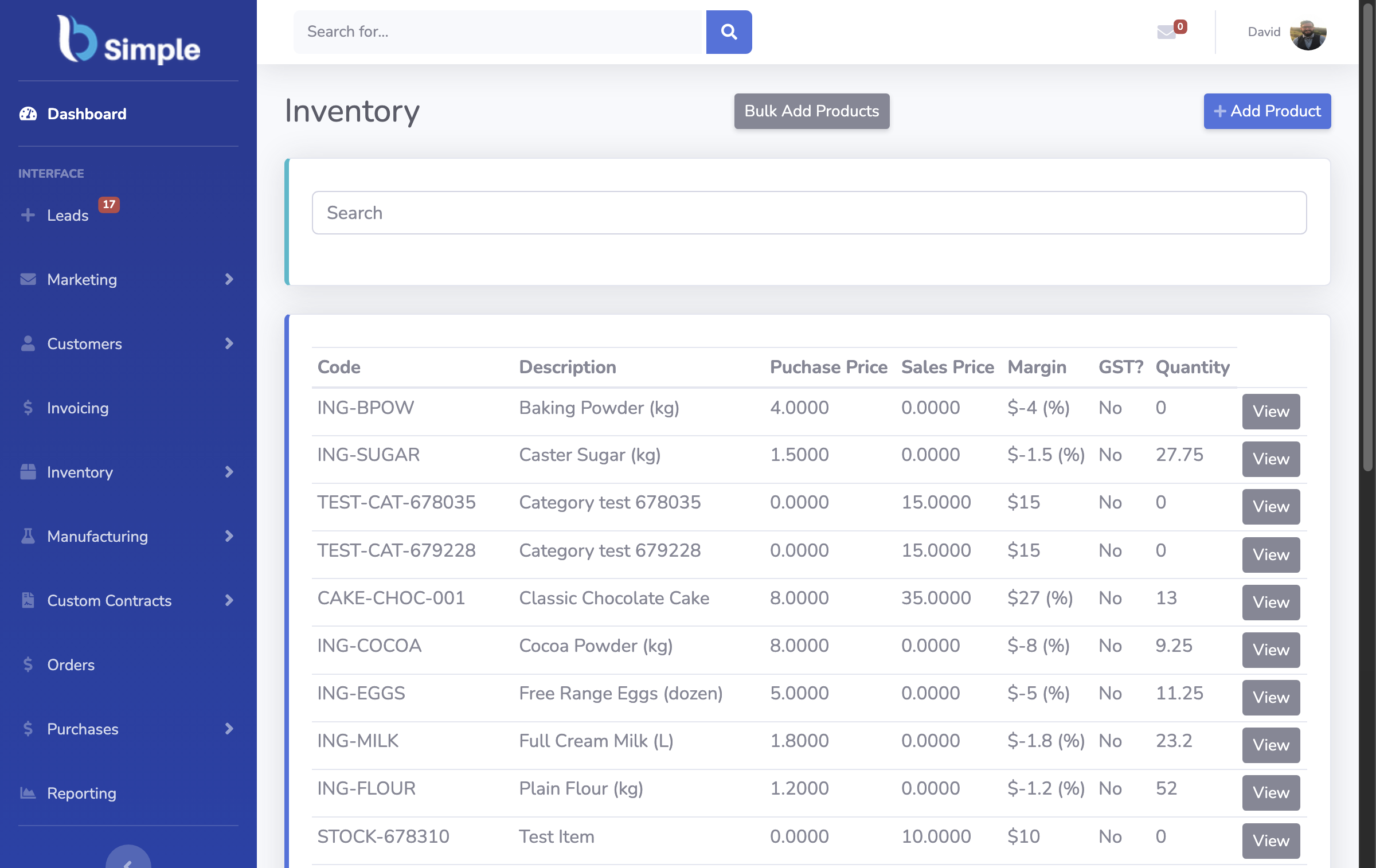
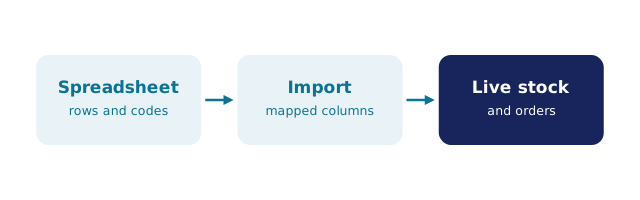
We build BSimple, so weigh that. Its design principle is that accounting stays in the accounting system: BSimple holds the operational record — live quantities across locations, multi-level stock, batch and expiry tracking, purchase orders from demand, order-to-invoice with approval, customer portals — and hands reviewed records to the books. Today that handoff is established with Xero and MYOB; US accounting integrations are rolling out, and until QuickBooks support is generally available we will not claim it — the current status is one honest question away.
If QuickBooks is your books today, the honest paths are the same three as ever: stay inside QuickBooks' module while volumes are simple; evaluate tools built around QuickBooks synchronisation if the books are a hard requirement; or run the operational record with a deliberate boundary while the US integrations land — the accounting overview explains why the boundary exists, and the buying decision frames the choice.
Frequently Asked Questions
Does QuickBooks have inventory management?
Yes — a built-in module with products, quantities, purchase orders and cost tracking. It suits simple, single-location stock; purchasing discipline, batch tracking and warehouse workflows are where third-party records take over.
Does BSimple integrate with QuickBooks?
Not yet as a finished integration. The established accounting handoff is Xero and MYOB, with US integrations rolling out. We will not claim QuickBooks support that does not exist — check the current status with us.
When is QuickBooks' inventory enough?
When stock is single-location, moves at accounting speed, and no one needs batches, portals or pick lists. The test: if quantities only matter at month-end, the module is fine; if they matter mid-shift, they need a record.
What breaks first when we outgrow it?
Usually multi-location truth or purchasing — two places holding stock, or reorder decisions made from memory. Both are operational-layer jobs, which is exactly what the trial demonstrates on your products.
Does BSimple cost more than staying in QuickBooks?
Yes — $180/$250/$399 per month AUD — because it does the job the module does not: the live operational record. Price it against the workarounds the module forces at your volumes, not against zero.

BSimple